If a storm tore the skirting off your manufactured home tonight, would your policy pay to put it back?
Mobile home insurance can feel confusing. The forms have different names, the rules change from one insurance company to the next, and Florida weather adds its own layer.
Here’s a plain-language look at what these policies cover, the main types you’ll see, and how to get the most protection for your money.
What mobile home insurance covers
Mobile home insurance, also called manufactured home insurance, protects the home and the life inside it. Most policies are built from a few core parts.
Dwelling coverage helps repair or rebuild the home itself after a covered loss. It often includes permanently attached structures like skirting, steps, and attached carports. Other structures coverage can protect things that stand apart, like a detached shed.
Personal property coverage helps replace your belongings, from furniture to clothes, after a covered event such as a fire or theft. Loss of use coverage helps pay extra living costs if you can’t stay home during repairs. Think hotel bills and meals out.
Liability coverage helps if someone is hurt on your property and you’re found responsible. Liability means your legal responsibility for injuries or damage to others.
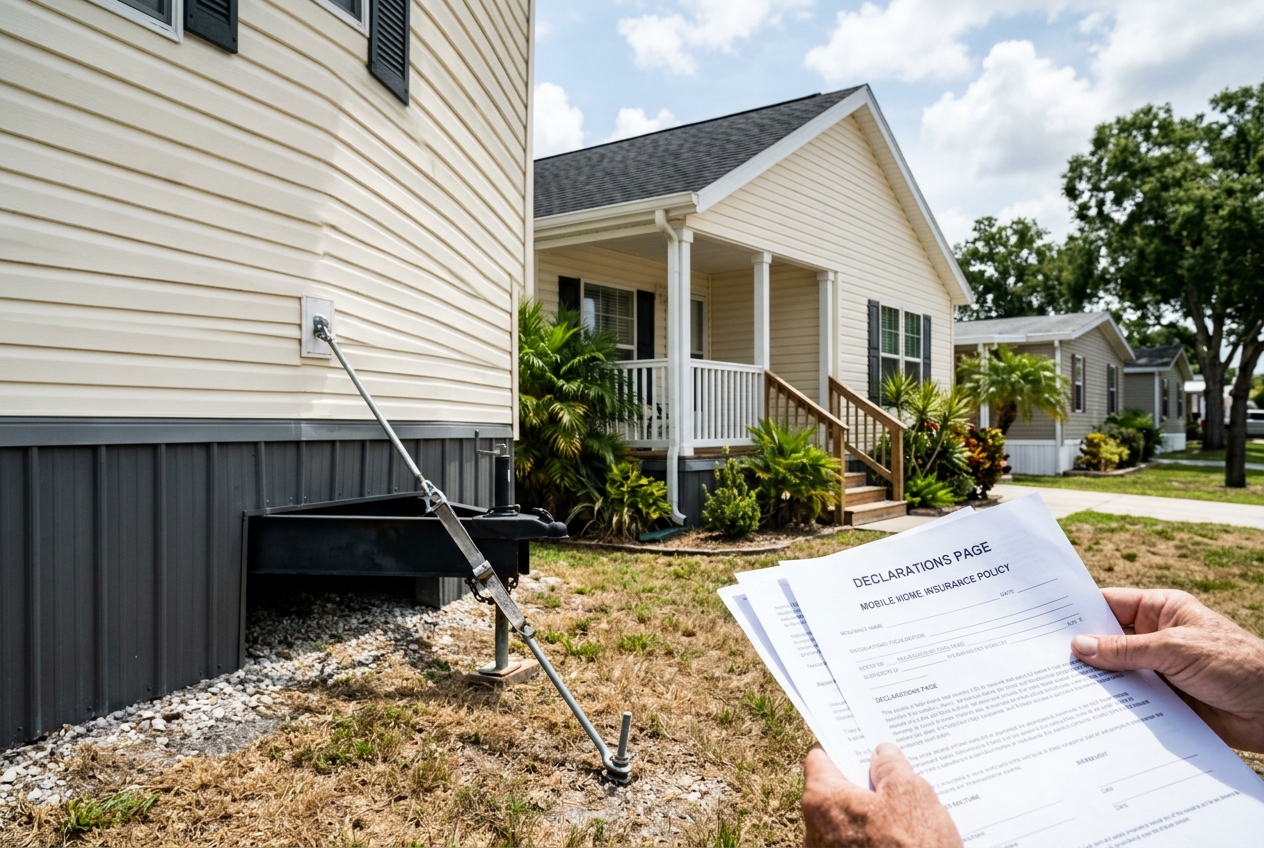
Some of these parts come standard and some are optional, depending on the form and the insurance company. Your declarations page, the summary at the front of your policy, shows what you really have.
One big item is usually missing. The Florida Department of Financial Services notes that a homeowners policy doesn’t cover flood damage. Most mobile home policies work the same way.
Understanding policy types
Not every mobile home policy is built the same way. The state notes that some insurance companies cover mobile homes with a dwelling form or an HO-7 form instead of a standard homeowners policy. An HO-7 is a form written for mobile and manufactured homes.
For most owners, the bigger difference is how a claim gets paid. Replacement cost pays what it takes to repair or replace the damaged item today. Actual cash value pays what the item was worth when it was damaged, after depreciation. Depreciation is the drop in value from age and wear.
Here’s a simple example. Say a storm ruins a 12-year-old roof. Replacement cost would help pay for a new roof. Actual cash value would pay much less, because the old roof had already lost value.
Your home’s age matters too. HUD’s manufactured home resources explain that homes built after June 15, 1976 must meet federal construction and safety standards and carry a red label on each section. The data plate inside lists the wind zone the home was built for. Some insurance companies look closely at these details before they offer a policy.
Maximizing protection benefits
Getting the most from your policy starts with the home itself.
Tie-downs are straps or cables that anchor your home to the ground so it stays put in strong winds. Have them checked, and keep the installer’s paperwork. The state’s Division of Emergency Management funds a Mobile Home Tie-Down Program run by Gulf Coast State College. It adds tie-downs at no cost to eligible homes installed in 1999 or earlier, though the waiting list can be long.
Next, set your limits with care. A limit is the most your policy will pay. Your dwelling limit should reflect what it would cost to replace your home today, not what you paid years ago.
Look at your deductible as well. That’s the amount you pay before coverage starts. A higher deductible can lower your premium, the price you pay for the policy. Just make sure you could cover it after a storm.
Last, keep a home inventory. Take photos or video of each room and save them online. Our hurricane preparedness resources can help you get ready before the season starts.
Frequently Asked Questions
What are the key differences in mobile home coverage?
Policies mostly differ in three ways. First is how claims are paid, either replacement cost or actual cash value. Second is what’s included, such as other structures, loss of use, or liability. Third is the deductible, including any separate hurricane deductible. Two quotes with similar prices can pay very differently after a storm, so compare the details line by line.
How does mobile home insurance differ from standard home insurance?
The basic idea is the same: protect the home, your belongings, and you from liability. The details differ. Mobile home policies often use their own forms and look closely at the home’s age, tie-downs, and setup. Some insurance companies don’t write mobile homes at all. That’s one reason an independent agency that compares several companies can help.
What additional coverages should I consider for natural disasters?
Start with flood insurance, since most mobile home policies leave flood out. A FEMA fact sheet says the National Flood Insurance Program offers manufactured homes up to $250,000 in building coverage and $100,000 for contents. The home must be properly anchored to qualify. Also ask how your policy handles wind and what your hurricane deductible is.
Find the right mobile home coverage in Palmetto
Your manufactured home deserves the same care as any other house. The right policy protects the structure, your belongings, and your peace of mind when the next storm rolls in from the Gulf.
Start by reading your declarations page. Check how claims are paid, what your limits are, and whether you carry flood coverage. Then look at your tie-downs and your home inventory.
If some of it feels unclear, that’s normal. These policies use plenty of jargon. Our job is to explain it in plain language before you buy.
Anderson & Associates Insurance is a family-owned, independent agency on 8th Avenue West in Palmetto. We’ve served the community since 1985, and mobile and manufactured homes are one of our specialties. Because we’re independent, we can compare coverage from multiple insurance companies. That matters when some companies pull back from writing mobile homes.
Learn more about our mobile home insurance options or meet the people on our team.
Ready for a fresh look at your coverage? Visit Anderson & Associates or contact us to talk with someone who knows your name.